A modern retention stack is the group of tools, a subscription platform, loyalty, subscriber email, AI support, and direct mail, that manage a subscriber’s lifecycle end to end. Most subscription brands already own a version of every layer. What is usually missing is a shared view of the subscriber across them, so a cancellation caught by one tool never reaches the others.
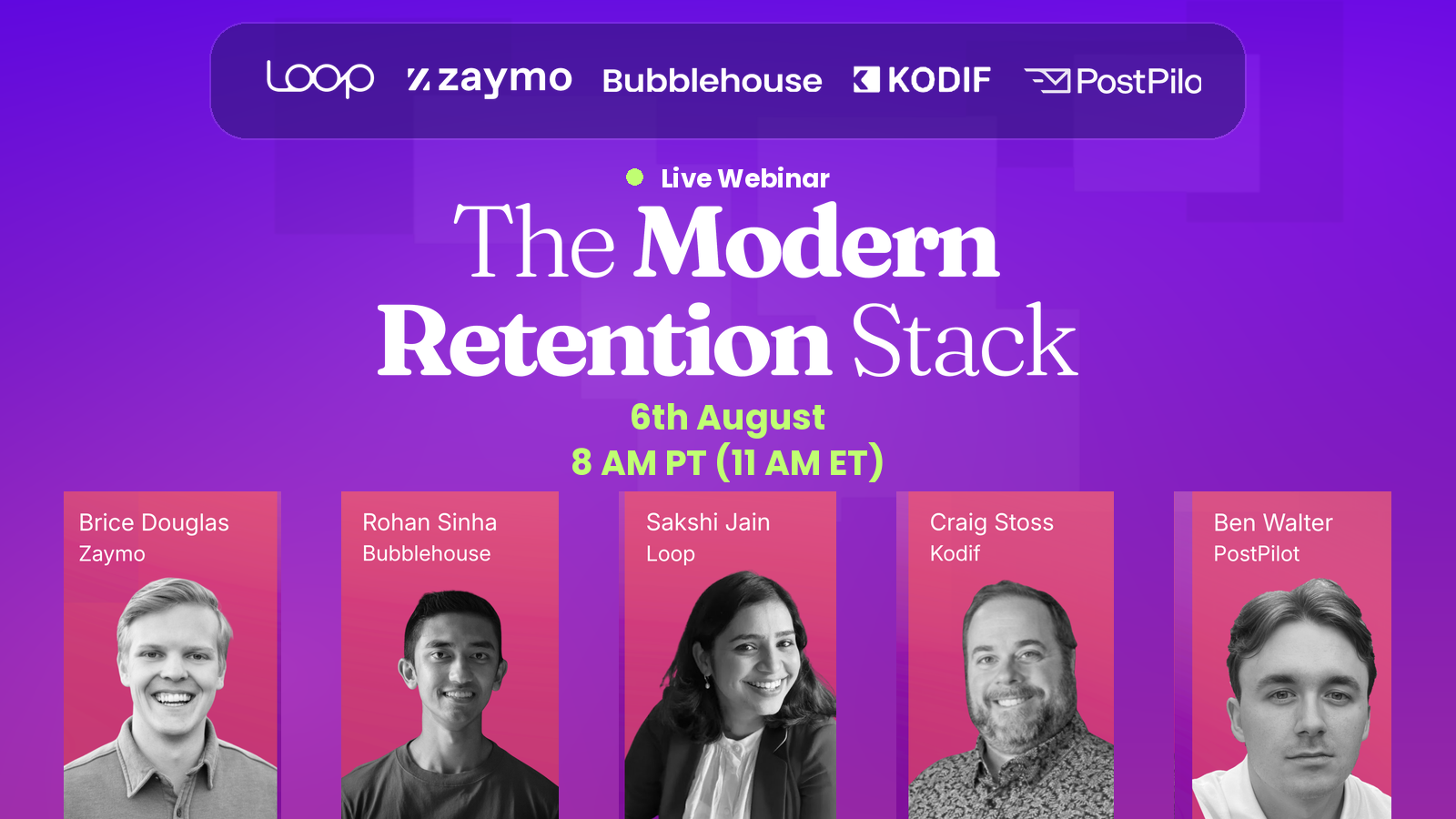
That was the premise of The Modern Retention Stack, a live co-marketing webinar hosted by Sakshi Jain, Growth & Partnerships at Loop Subscriptions. Four partner speakers joined her: Rohan Sinha of Bubblehouse on loyalty built for subscriptions, Bryce Douglas of Zaymo on subscriber email, Craig Stoss, VP of Solutions at Kodif, on action-taking AI agents, and Ben Walter, Global Partnerships at PostPilot, on direct mail. Here is what each of them said, in their own numbers.
Five speakers, five layers of the same stack:
| Layer | Company | Speaker | On-record proof point |
|---|---|---|---|
| Subscription platform | Loop Subscriptions | Sakshi Jain | 2,400+ brands, $4B+ processed, 74% mystery-reward claim rate |
| Loyalty | Bubblehouse | Rohan Sinha | 142% LTV increase from active loyalty participation |
| Subscriber email | Zaymo | Bryce Douglas | 10% LTV lift in 37 days from one billing-reminder rebuild |
| AI support agents | Kodif | Craig Stoss | 121,000 resolutions/year, 77% chat containment, for Dollar Shave Club |
| Direct mail | PostPilot | Ben Walter | 2-3% conversion needed to break even on a $0.60-0.65 postcard |
Key takeaways
- Loop’s subscription platform processes $4 billion or more in subscription revenue across 2,400+ Shopify brands, and treating churn as one dashboard number instead of splitting voluntary from involuntary churn hides where the real fix belongs (Loop, Sakshi Jain).
- Subscribers who actively engage with a loyalty program show a 142% increase in member lifetime value and a 36% increase in subscription retention (Bubblehouse, Rohan Sinha).
- Rewriting a single billing reminder email lifted one brand’s subscriber LTV 10% over 37 days, worth about $8 more per subscriber in that window (Zaymo, Bryce Douglas).
- Action-taking AI agents handle roughly 121,000 resolutions a year for Dollar Shave Club at a 77% chat containment rate, saving about 114 subscriptions a month through in-conversation retention offers (Kodif, Craig Stoss).
- A personalized postcard triggered at cancellation costs roughly $0.60 to $0.65 to send and needs only a 2-3% conversion rate to pay for itself at a typical $65-75 order value (PostPilot, Ben Walter).
Watch the full session
Why does every modern retention stack still leak subscribers?
Because each tool only sees its own slice of the subscriber, not the whole journey. Sakshi Jain opened by pointing out that most brands already own a version of every retention layer, an ESP, a help desk, a loyalty app, a subscription app, and still cannot answer a basic question: what share of last month’s canceled subscribers left because a payment failed, not because they chose to leave.
That gap matters because voluntary churn and involuntary churn need different fixes entirely. Voluntary churn, a subscriber actively canceling, pausing, or skipping, responds to cancel-and-save flows and education about why they subscribed in the first place. Involuntary churn, a card that expired or a payment that failed, is often invisible to the subscriber and the brand alike, and it sits on recoverable revenue already sitting in the account.
Loop, the subscription platform running the webinar, works with 2,400+ Shopify brands and has processed more than $4 billion in subscription revenue across 1,100+ migrations. Sakshi Jain described three fixes Loop built for different points in that churn curve. Streaks reward subscribers for consecutive orders instead of discounting order three, the point where many subscription programs die once an initial discount expires. Mystery rewards target the moment of highest risk directly: Loop found that 70% of portal visits carry negative intent (skip, pause, cancel, or reschedule), so a surprise-gift prompt appears right as a subscriber is about to act. Across Loop’s merchant base, that prompt has been triggered 5 million times and claimed 3.7 million times, a roughly 74% claim rate on turning a canceling visit into a positive moment.
The third fix targets involuntary churn directly: smart payment retries tuned to the failure type, one-click card updates with no login wall, and an incentivized recovery campaign for accounts that exhaust retries. Sakshi Jain cited one Loop customer, Lumen, that recovered an incremental 12.6% of revenue through payment recovery in four months, with no new discount and no new creative.
Does loyalty actually move subscription lifetime value?
Yes, according to Rohan Sinha of Bubblehouse: brands that get subscribers actively participating in a loyalty program see a 142% increase in member lifetime value, a 36% increase in subscription retention, and a 28% increase in subscription conversion.
Rohan Sinha framed loyalty’s job as giving subscribers an emotional and transactional reason to stay once acquisition spend has already been spent. Three modern loyalty patterns drove those numbers, in his account. AI personalization targets reward offers, like double-points days, only at the segment of subscribers who have actually responded to that offer before, instead of blasting it to everyone. Full portal integration puts tier status, point balances, and milestone rewards directly inside the subscription portal, the same central hub Sakshi Jain described, rather than a separate rewards page. Gamification ties specific milestone rewards to the cross-sell behaviors that correlate with higher lifetime value for that brand.
Two newer plays extend loyalty beyond the transaction. Social tracking lets subscribers connect Instagram or TikTok to their Shopify profile and earn rewards automatically for posts, stories, or comments, a tactic Rohan Sinha said One Size Beauty has used to drive a large jump in UGC submissions. Receipt upload rewards subscribers for photographing a retail purchase (Whole Foods, Target, Walmart), using AI to match the products and reward the purchase, which gives a DTC brand a direct line to a customer it otherwise cannot identify in retail. Mary Ruth’s, sold across Whole Foods, Target, and Amazon alongside DTC, was the case study for combining all three patterns.
Is the billing reminder email actually driving cancellations?
Usually not by itself, but the standard way brands measure it makes it look that way. Bryce Douglas of Zaymo said most email attribution tools count a cancellation against whichever message a subscriber last opened, which blames the billing reminder for churn that was already happening. The only reliable read, he said, is a holdout test tracking cohort LTV over time, not open-based attribution.
When Zaymo ran that kind of test with one brand, optimizing the billing reminder produced a 10% LTV lift over 37 days, worth roughly $8 more per subscriber across that cohort. The change was not a subject-line trick. Zaymo helped Harry’s rebuild its billing reminder as an interactive email that embeds the subscription portal directly in the inbox: subscribers can swap sizes, delay or send an order now, change the delivery date, or add a one-time cross-sell product without leaving the email. The logic mirrors Loop’s mystery-reward placement: since around 70% of portal visits carry negative intent, bringing positive actions into the inbox beats funneling subscribers toward the portal in the first place.
Asked live which single email a brand should fix first, Bryce Douglas repeated the billing reminder, citing a 5-15% LTV lift range Zaymo sees across brands, with reactivation emails for lapsed subscribers as the next best lever: rewriting how a brand talks about reactivation typically produces a 50% higher reactivation rate. Zaymo’s client list includes Dr. Squatch, Dollar Shave Club, Harry’s, IMA, Carpe, Groons, and True Classic.
Can an AI agent actually change a subscription, not just answer a question about it?
Yes. Craig Stoss, VP of Solutions at Kodif, drew a direct line between the two: most AI agents are built to answer FAQs and get measured on containment, how many conversations never reach a human. Kodif is built for the action-taking side instead, recognizing the same negative intent Sakshi Jain described and then executing the change itself, whether that means pausing a subscription, updating an address, or connecting into a system like Loop to apply its retention rules inside a chat or email conversation.
In practice, that means Kodif’s AI recognizes an intent (cancel, pause, address change, or something more specific to the brand), pulls the relevant backend rules, and writes a personalized response before making the update directly in the subscription or order system. Craig Stoss said the logic is written by CX teams in plain English against past conversations, no developers required, and it can flex for sensitivity: an AI agent trained on a pet-related product line, for example, recognizes when a customer mentions losing a pet and skips the retention offer entirely.
Dollar Shave Club, one of Kodif’s longest-running customers, illustrates the scale: Kodif’s AI Agent handles about 121,000 resolutions a year for the brand at a 77% containment rate on its chat channel, and roughly one in eight of those conversations involves some form of retention. That works out to about 114 subscriptions saved a month through alternatives like a pause instead of a cancellation, 1,800 address changes processed a month, and roughly 2,300 cancel-subscription flows a month handled through the AI chat widget, a mix Craig Stoss said saves the brand about a third of the cost associated with those interactions. See the full Dollar Shave Club case study for more on the deployment.
Asked which workflow a team should hand to AI first, Craig Stoss said it depends on where an account’s agent time actually goes: high-volume, repeatable lookups like order status and lost packages, or slower, backend-heavy work like address changes and warehouse or 3PL checks, whichever is eating the most agent hours in a given account.
Is a postcard still worth it when subscribers already ignore email?
Yes, particularly for the subscribers who have already gone quiet on your other channels. Ben Walter of PostPilot opened with the gap most retention plans miss: even strong email programs are opened by roughly 20-40% of a list at best, which leaves a brand’s best cohort, people who already bought and already like the product, sitting unreached once they stop opening messages.
PostPilot integrates with Shopify and Loop and runs the design and account management for a brand’s direct mail. Ben Walter walked through three automations built for this webinar’s audience specifically. Subscription save triggers a personalized postcard the moment Loop captures a cancellation reason, including a QR code that scans straight back into the subscription flow. Lapsed buyer win-back uses webhook triggers from a flow like Klaviyo to send a card when a subscriber stalls before converting into a repeat cycle. VIP over-serving reserves premium formats, including handwritten cards, for a brand’s highest-value subscribers as a surprise rather than another discount.
Cost is what makes the math work: printing and delivery for a standard piece starts around $0.60 to $0.65, rising for premium formats like handwritten cards. At a typical $65-75 average order value, Ben Walter said most brands only need a 2-3% conversion rate on a mailed piece to see a positive return. PostPilot has run subscription-save and win-back programs with supplement brand Omino, working alongside agency Rock City Labs, among other consumable subscription brands. Asked what actually makes a card convert, Ben Walter ranked timing and segmentation first, ahead of design: colder audiences get larger formats like catalogs, warmer repeat buyers get a smaller 4×6 or 6×9, and VIPs get the handwritten card, with personalization (first name plus up to three custom fields) and a QR experience tied back into Loop layered on top.
The numbers side by side
- 74% claim rate: 3.7 million of 5 million Loop “mystery reward” prompts triggered at the point of cancellation intent were claimed (Loop, Sakshi Jain).
- 142% LTV increase: for subscribers who actively engage with a Bubblehouse loyalty program, versus those who do not (Bubblehouse, Rohan Sinha).
- ~33% cost reduction: on support costs tied to retained subscriptions, from Kodif’s AI-driven pause, address-change, and cancellation flows for Dollar Shave Club (Kodif, Craig Stoss).
“No single tool wins retention.” (Sakshi Jain, Loop Subscriptions)
Frequently asked questions
What is a modern retention stack?
A modern retention stack is the connected set of tools, subscription platform, loyalty, email, AI support, and direct mail, that manage a subscriber’s full lifecycle. Most subscription brands already own every layer; the stack only becomes “modern” once those tools share subscriber data instead of working from five separate, disconnected views of the same customer.
What’s the difference between voluntary and involuntary subscriber churn?
Voluntary churn is a subscriber actively canceling, pausing, or skipping. Involuntary churn happens when a payment fails or a card expires and the subscriber often does not realize they have churned. Loop’s Sakshi Jain says each needs a separate fix: cancel-and-save flows and education for voluntary churn, smart payment retries and one-click card updates for involuntary churn.
Which subscriber email should a brand fix first to lift LTV?
Zaymo’s Bryce Douglas points to the billing reminder. For one brand, optimizing it, including giving subscribers in-inbox control over swaps, skips, and delivery dates, produced a 10% LTV lift within 37 days, and Zaymo generally sees a 5-15% LTV lift from billing reminder work across brands.
Can an AI agent actually change or cancel a subscription, not just answer questions about it?
Yes. Kodif’s Craig Stoss says action-taking AI agents connect directly to backend systems like a subscription platform to execute changes, canceling, pausing, or updating a subscription, in the same conversation, instead of only answering FAQs. For Dollar Shave Club, Kodif’s AI handles about 121,000 resolutions a year at a 77% chat containment rate, and roughly one in eight of those conversations involves some form of retention action.
Does loyalty actually move subscription lifetime value?
Yes. Bubblehouse’s Rohan Sinha cites a 142% increase in member lifetime value and a 36% increase in subscription retention once subscribers actively participate in a loyalty program, plus a 28% increase in subscription conversion.
Is direct mail still worth it for subscriber retention?
Yes, especially for lapsed and VIP subscribers who have stopped opening email. PostPilot’s Ben Walter says a personalized postcard triggered at cancellation, at roughly $0.60-$0.65 per piece, needs only a 2-3% conversion rate to pay for itself at a typical $65-75 order value.
About this webinar
The Modern Retention Stack was a live co-marketing webinar hosted by Loop Subscriptions, bringing together four partner speakers, Bubblehouse, Zaymo, Kodif, and PostPilot, to walk through how their tools connect across a single subscriber journey. Sakshi Jain of Loop moderated. This recap draws only from what each speaker said on the call, operator to operator, not vendor marketing copy.
See what action-taking AI looks like inside your modern retention stack
Kodif’s AI Agent connects to the systems you already run, Loop included, so retention offers turn into an actual pause, skip, or address change inside the conversation, not just an answer. See Kodif in action.