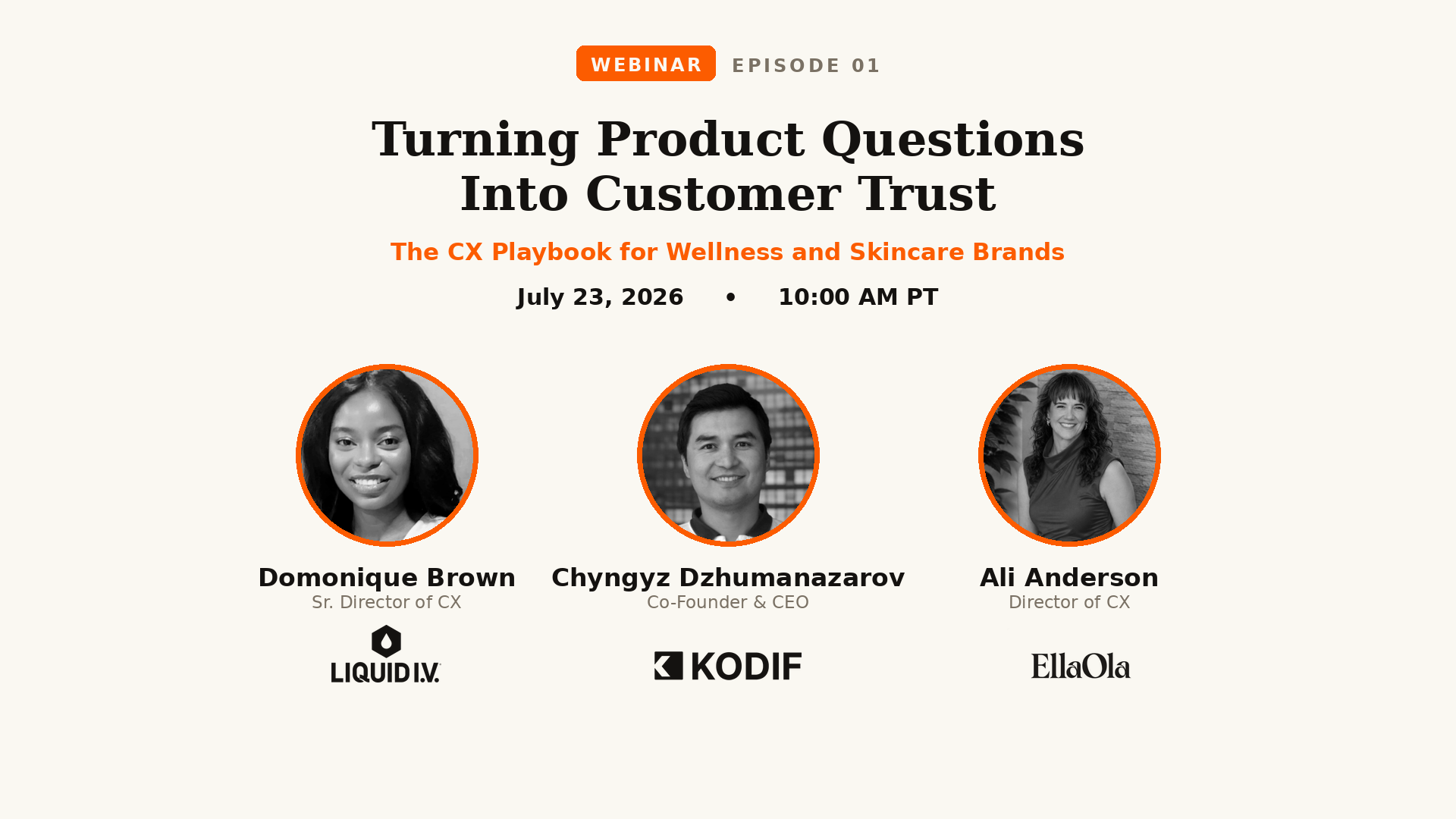
TL;DR: Wellness brands earn customer trust by building CX foundations before adding tooling, keeping a tight feedback loop with regulatory teams so agents never cross into medical advice, and introducing AI only once they know exactly which problem it solves. In the first episode of the Virtual Growth Story webinar series, Liquid I.V.’s Domonique Brown and EllaOla’s Ali Anderson walked through how that plays out at two very different stages of growth.
Most CX advice assumes every brand is the same size with the same tools. That breaks fast in wellness, where one bad automation call can undo years of trust. Domonique Brown, Sr. Director of CX at Liquid I.V., scaled the brand’s support function from roughly $20 million in revenue to over $1 billion, across 120,000+ retail doors and 12+ countries (Source: Domonique Brown, Sr. Director of CX, Liquid I.V., Virtual Growth Story webinar, 2026). Ali Anderson, Director of CX at EllaOla, joined the science-led family wellness brand after building CX at Primal Harvest and is shaping its foundation from scratch. Moderated by Chyngyz Dzhumanazarov, the two covered CX at different growth stages, the medical-advice line, team retention, and why AI works only when it solves a named problem.
How does CX change as a wellness brand scales from $20 million to $1 billion?
Early on, CX runs on founder knowledge: no SOPs, no playbooks, no documentation, just the people who’ve been there since day one. Ali Anderson called this great for closeness to the customer but fragile, since “some of that foundational knowledge kind of just gets flickered down” as teams grow. The fix: move from individual knowledge to systems anyone can rely on, documentation, playbooks, QA, and clear escalation ownership.
CX foundation: the documented playbooks, escalation paths, and QA processes that let a support team make consistent decisions without relying on any one person’s memory.
Domonique Brown lived the next stage of that arc. In Liquid I.V.’s early days, “no one knew who we were,” and the job was building the voice of the customer into FAQs and product pages while the brand pushed into major retail. As Liquid I.V. became a household name, the question shifted from “what is this” to “how do I know this is the best choice,” moving CX from education toward proving trust. Ali’s summary: “your foundation is just like building a house. If you don’t have your foundation in order, it’s really hard to put up the pretty wallpaper.”
How do you answer wellness product questions without giving medical advice?
Lead with empathy and nutritional knowledge, and stop short of diagnosis. Ali Anderson put it directly: when a customer describes a symptom, the answer isn’t “go talk to your doctor,” it’s offering nutritional context they can bring to their own doctor. That starts with someone on the team who understands basic medical needs, since health-claim regulations vary by country and change constantly.
Liquid I.V. sits in a different regulatory lane: the FDA classifies it as a beverage, not a supplement, changing how the brand can legally describe its own product. Domonique Brown built a close relationship with the regulatory team to translate scientific language into something customers understand: “I would send a question over and they would send back like four paragraphs, and there is zero way the customer is going to understand any of what you just said.” That translation work becomes public FAQs, and later, automation.
How do you build a CX team that stays, instead of one that churns?
Give people ownership of outcomes, not just tickets. At Liquid I.V., Domonique Brown built a feedback-driven culture from day one, with founding managers shaping what good service looks like and town halls where the team drives process changes. The payoff: agents who started answering tickets now manage their own teams. Her read on why it works: CX usually generates ideas without controlling outcomes, so a real seat in those decisions is “a much more rewarding experience.”
Ali Anderson faced a different challenge: inheriting a team she didn’t build. Her approach is to spend the first three months listening, treating the existing team as the real voice of the customer and the workflow. She also works the inbox herself several hours a week before changing anything.
Why did Liquid I.V. and EllaOla move on from their help desk’s built-in AI?
Because native AI features shipped without the training CX teams needed. Domonique Brown tested Liquid I.V.’s AI inside Gorgias and Zendesk first: automation stayed low, what did run created friction, and her team spent hours building back-end workflows that broke often. Ali Anderson’s team hit a different wall at a prior brand: they ran out of usable knowledge capacity in the help desk’s AI, a real problem when wellness customers ask detailed questions at all hours.
One attendee, herself a longtime Liquid I.V. customer, asked live exactly when a brand should conclude its out-of-the-box AI isn’t enough. Domonique Brown’s answer: when speed and iteration matter more than a generalist help desk can support, that’s the signal for an AI-specific partner.
What should CX leaders do, and avoid, before turning on AI?
Get clear on the reason before touching the tooling. Ali Anderson’s warning: “don’t just implement AI to implement AI.” A goal limited to cutting cost per ticket misses what AI can do for retention and education, and sizing investment by ticket-type percentage alone is a trap: a high-volume category might cost little agent time while a smaller one eats several manual steps.
| Do | Don’t |
|---|---|
| Train your team to use AI as a resource, not a black box | Rush the decision before naming your actual “why” |
| Have agents try to break the AI to test compliance and edge cases | Size AI investment by ticket-type percentage alone |
| Test the AI cross-functionally, including regulatory and product teams | Build AI in a vacuum, judged only by the CX team |
| Pick a partner investing in your brand’s success long-term | Optimize for cost savings if it adds customer friction |
Liquid I.V. lived that third row: its Chief Digital Officer, product, and regulatory teams tested the chatbot for tone and compliance before launch.
What did AI actually change at Liquid I.V.?
It gave the brand 24/7 coverage without a 24/7 team, and freed agents for harder, more satisfying work. Liquid I.V.’s customers browse the site around the clock; support didn’t, and the gap widened every peak hydration season. Partnering with Kodif in chat, product questions first, closed it: Liquid I.V. reached 80% overall ticket automation and more than 90% on product questions, without a drop in satisfaction, while in-house agent CSAT rose 6 percentage points as agents handled fewer repetitive tickets and more complex cases (Source: Domonique Brown, Sr. Director of CX, Liquid I.V., Virtual Growth Story webinar, 2026). That freed capacity also let the team expand into TikTok Shop and Amazon.
Where should CX sit in the org chart, and does it conflict with retention goals?
There’s no single right seat, as long as CX has a voice that reaches across departments. Domonique Brown’s team has reported to the CEO, then e-commerce, and now sits under digital, e-commerce, and media. Ali Anderson has seen CX sit under marketing, and at EllaOla she reports directly to the founders. Her framing: CX exists to close the gap between operations, acquisition, and marketing.
A second attendee, whose own CX org sits under supply chain, asked whether AI-driven retention creates tension with support’s core job. Domonique Brown’s answer: it shouldn’t, because CX is already a retention lever through its direct access to the customer. With AI in place, Liquid I.V. can test a cancellation flow or a win-back offer inside chat itself and get a real read within a week, work that used to sit solely with retention.
Key Takeaways
- CX foundations, not tooling, earn a wellness brand trust: documentation, escalation paths, and QA come before automation.
- Answer product questions without giving medical advice by leading with empathy and nutritional context, then routing diagnosis to a doctor.
- Low CX attrition comes from giving agents real ownership over outcomes and a visible growth path, not perks.
- Liquid I.V. hit 80% overall automation and 90%+ on product questions while agent CSAT rose 6 points, proof AI and human satisfaction can rise together.
- Adopt AI for a named reason, test it cross-functionally, and measure it by customer experience first, cost second.
Wellness brands don’t earn trust with a chatbot. They earn it by knowing exactly what they can and can’t say, and by automating only the parts that don’t need a human judgment call. See Kodif in action.